

Benefits of Rose Water | Rosa Damascena Explained
The benefits of rose water, distilled from the petals of “Rosa Damascena,” have been observed in traditional and research settings alike, spanning antioxidant, anti-ageing, anti-inflammatory, and relaxation effects.
Rose water is also associated with anti-diabetic properties due to its bioactive compounds and with hypnotic effects—a term describing substances that support sleep or ease anxiety —largely through the influence of its aroma on olfactory pathways. This article considers some of its promising observations.
What Are The Benefits Of Rose Water?
Research on Rosa Damascena links rose water to antioxidant, anti-inflammatory, antibacterial, and hypnotic (potentially sleep-supportive) properties. Controlled studies report calming effects on the nervous system, possible support for cognitive and cardiovascular function, and antimicrobial activity relevant to oral and respiratory health. Individual suitability varies, and rose water is not a substitute for medical care.
Key Points In This Article
This article examines the benefits of rose water made from Rosa Damascena, also known as Damask rose. It explores the bioactive compounds behind its therapeutic reputation, the case studies and research that shape current understanding, and its role in traditional Persian and Ayurvedic systems.
Benefits Of Rose Water & Roses
The use and benefits of rose water have been documented throughout history, and roses are recognised worldwide.
Roses belong to the Genus Rosa, part of the Rosaceae family, with an estimated 200 species worldwide (Wang et al., 2022).
For centuries, rose water has been used for its fragrance and its associated therapeutic effects. Its scent is often linked with relaxation or mild sedation, and it remains particularly popular across the Middle East and South Asia.
Pure Rose Water
Rose water is produced by steeping rose petals in distilled water.
Steeping releases essential oils and natural fragrance compounds into the water. The resulting liquid is strained before use.
Types of Rose In Rose Water
The rose species used to produce a given rose water varies, and the resulting bioactive profile — and therefore the associated properties — can differ accordingly.
Roses Traditionally Associated With Specific Properties
The non-exhaustive list below reflects traditional and horticultural associations rather than a single controlled clinical comparison across species.
- Damask Roses — associated with anti-inflammatory and antioxidant properties.
- French Roses — associated with calming and relaxing effects.
- Bulgarian Roses — associated with circulatory and skin-supportive use.
- Alba Roses — associated with antibacterial properties and skin soothing.
- Tea Roses — associated with astringent and toning use.
- Rugosa Roses — noted for vitamin C content.
- Centifolia Roses — associated with calming use.
- Gallica Roses — associated with anti-inflammatory and antiseptic use.
Therapeutic Properties Of Rose Water
Roses are studied for several phytotherapeutic actions linked to compounds found across the plant’s organs.
For instance, Wang et al. (2022) reported the following:
- Cherokee rose was found to have a total flavonoid content of roughly 80.5%, higher than that measured for Rosa canina, Rosa rugosa, and Rosa roxburghii, using a colorimetric method.
Boskabady et al. (2011) reviewed the pharmacological literature on Rosa Damascena and reported evidence, across different extract types and in vivo or in-vitro models, for the following effects:
- Hypnotic and central nervous system depressant activity (increased pentobarbital-induced sleep time in vivo model)
- Antitussive and bronchodilatory activity relevant to respiratory support
- Laxative and prokinetic activity relevant to digestive function
- Anti-inflammatory activity observed in vivo models
Separately, a 2021 systematic review and dose-response meta-analysis (Rasooli et al.) examined Rosa Damascena’s effect on anxiety, depression, and stress in adults — discussed further below.
Rosa Damascena “Damask Rose” & Its Rose Water
Among rose species, Rosa Damascena is particularly noted for its therapeutic reputation.
Its fragrant petals are associated with mood elevation and relaxation, which is why it is common in aromatherapy.
The Damask rose — closely related to Rosa moschata and known as Desi Gulab in India — has several Ayurvedic uses, including as a metabolic coolant and in support of low mood.
Aromatic Characteristics of Damask Rose
Damask rose has a rich, complex aroma combining sweet, floral, and citrusy notes — refreshing on first impression, with a lingering, warmer undertone often described as comforting.
Origins Of Damascena Rosa
The Damask rose is generally understood to have originated in the Middle East, with strong historical ties to Damascus, Syria, and to Iran.
Bulgaria, Turkey, Iran, and India are among the main cultivators today, given their favourable growing conditions. Rose oil production is a significant industry in these regions, with Bulgaria among the largest exporters. Smaller-scale cultivation also occurs in Morocco, Egypt, France, and Italy.
Plant Organs Used In Rose Therapeutics
The parts of the Damask rose used for their therapeutic properties include:
- Flower heads
- Petals
- Hips (seed pods) / rosehips
Bioactive Compounds In Damascena Rosa
Damask rose is studied for its anti-inflammatory, antimicrobial, and antioxidant properties.
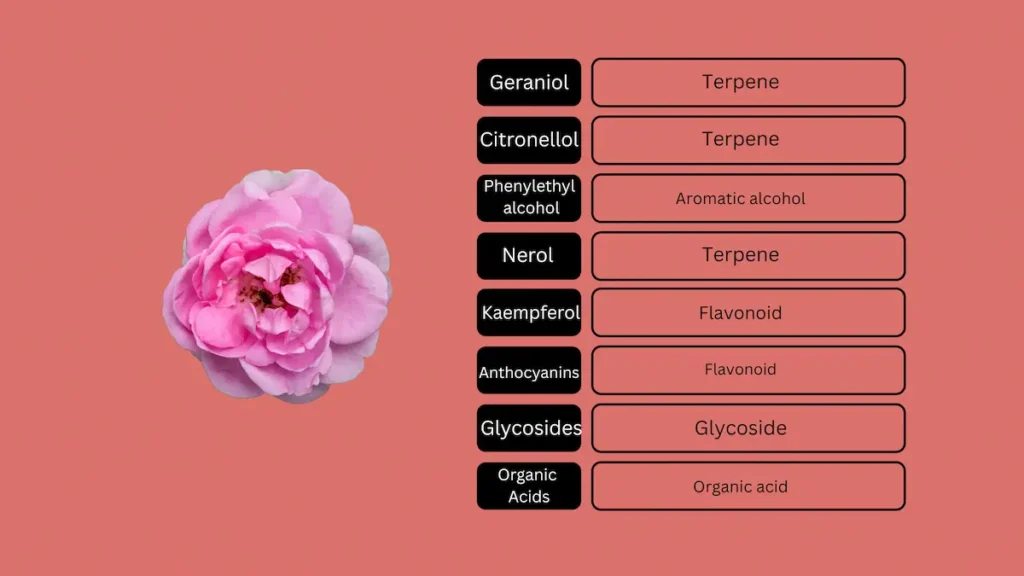
The plant contains several phytochemical compounds, including geraniol and citronellol, with recognised pharmacological relevance.
According to Boskabady et al. (2011), researchers have isolated a range of components from different parts of Rosa damascena, including terpenes, glycosides, flavonoids, and anthocyanins, as well as carboxylic acids, myrcene, vitamin C, kaempferol, quercetin, tannins, fatty oils, and other organic acids.
Examples Of Compounds
Damascena rose floral water (hydrosol) contains four principal constituents. Geraniol is the main compound, followed by citronellol, phenylethyl alcohol, and nerol (Boskabady et al., 2011).
In 2007, Loghmani-Khouzani et al. identified more than 95 macro- and micro-components in the essential oil of Damascena Rosa from the Kashan region:
- Eighteen compounds made up over 95% of the total oil.
- The main components were β-citronellol, nonadecane, geraniol, and nerol, with kaempferol also present in significant amounts.
In rose absolute, the major compounds identified were phenyl ethyl alcohol (an organic alcohol), citronellol, geraniol, and nonadecane, with smaller amounts of ethanol and heneicosane.
Trace Elements Of Damascena Rosa
Beyond its therapeutic compounds, Damascena Rosa also contains trace elements relevant to a well-balanced diet. Kumar, Kaur, Joshi, and Kumar (2017) — in “Rosa Damascena: Quality Evaluation and Process Optimisation for the Development of Rose Syrup” — identified potassium, phosphorus, calcium, copper, and iron among the minerals present in fresh Damask petals.
This trace-element content relates to fresh petals rather than finished rose water, and is often overlooked relative to the plant’s aromatic and phytochemical properties.
Examples: Antibacterial Properties & Research Applications
Rosa Damascena products have shown broad-spectrum antibacterial activity in laboratory studies against both gram-positive and gram-negative organisms, including Staphylococcus aureus, Escherichia coli, and Pseudomonas aeruginosa (Boskabady et al., 2011).
A 2023 randomised controlled trial examined rose water mouthwash, combined with chlorhexidine, in 80 mechanically ventilated patients in a surgical intensive care unit. The intervention group showed a significantly lower incidence of early-onset ventilator-associated pneumonia (2.5%) than the chlorhexidine-only control group (12.5%, p=0.021). No significant difference was found for late-onset pneumonia, ventilation duration, ICU stay, or mortality (Dobakhti et al., 2023).
The study authors proposed that rose water may interfere with early bacterial biofilm formation, while having less effect on the more antibiotic-resistant flora typically associated with later-onset infection — a single-centre finding that the authors themselves note would benefit from replication.
Potential Metabolic & Anti-Ageing Effects
In animal models, oral administration of a methanol extract of Rosa Damascena reduced blood glucose after a maltose load in both normal and diabetic in vivo studies, in a dose-dependent manner, with the plant identified as a potent inhibitor of the α-glucosidase enzyme (Boskabady et al., 2011).
Separately, supplementing fruit flies (Drosophila melanogaster) with a rose-flower extract significantly reduced mortality rate in both males and females, with researchers proposing the plant’s antioxidant properties as a possible mechanism (Boskabady et al., 2011, citing Jafari et al., 2008). This finding is specific to an in vivo animal model and has not been established in human studies.
Potential Influence On Brain-Friendly Function
Boskabady et al. (2011) noted evidence that Rosa Damascena may support aspects of brain function relevant to dementia, including cognitive performance in vivo models.
Separately, Awale et al. (2009) studied the neurite outgrowth activity of a chloroformic extract of Damascena Rosa and reported that it significantly promoted nerve cell growth while inhibiting amyloid β (Aβ) accumulation — a protein fragment linked to Alzheimer’s disease.
Potential Anti-Stress, Depression & Anxiety
Rasooli et al. (2021) conducted a systematic review and dose-response meta-analysis of randomised controlled trials examining Rosa Damascena Mill for anxiety, depression, and stress in adults, reporting a calming effect on the nervous system that may help alleviate these symptoms. The study was published in Phytotherapy Research (vol. 35, no. 12); DOI: 10.1002/ptr.7243.
A larger 2025 systematic review and meta-analysis (Xu et al.), pooling 28 randomised controlled trials, reported a significant reduction in anxiety symptoms and stress symptoms with Rosa Damascena aromatherapy, alongside a modest reduction in mean arterial pressure. Depressive symptoms specifically were not significantly reduced in this pooled analysis — an open question the authors attribute to the small number of trials measuring depression directly, rather than confirmed evidence of no effect.
Notably, 85.7% of the trials in this meta-analysis were limited to a particular region, which is relevant when assessing how far these findings generalise to other populations and settings.
Potential Sleep Quality & Calming (Hypnotic) Effects
Mahdood, Imani, and Khazaei (2022) conducted a randomised controlled trial examining inhalation aromatherapy with Damask rose oil among 80 operating-room personnel, over 30 consecutive nights, during a period of heightened pandemic-related anxiety and disrupted sleep.
Participants inhaled the oil (or a paraffin placebo) directly at the start of a shift in this study, then attached a cloth napkin holding drops of the same product near their pillow for around eight hours a night. Both state anxiety and sleep quality — measured using the Pittsburgh Sleep Quality Index — improved significantly more in the rose oil group than the placebo group by day 31 (p<.001 for both measures).
A larger 2025 meta-analysis of 28 randomised controlled trials (Xu et al.) similarly reported a significant improvement in sleep quality with Rosa Damascena aromatherapy overall, most notable in middle-aged and older adults. The reviewers also noted substantial variation between the underlying studies, worth bearing in mind when interpreting the pooled result.
Flavonoid Glycosides & Cardiovascular Function
Kwon et al. (2010) identified flavonoids from the buds of Rosa Damascena that inhibit the activity of both HMG-CoA reductase and angiotensin-converting enzyme (ACE) — enzymes relevant to cholesterol synthesis and blood-pressure regulation respectively. Among these, Boskabady et al. (2011) highlight one specific compound, cyanidin-3-O-β-glucoside, as significantly suppressing ACE activity.
Flavonoids more broadly are studied for their potential to support cardiovascular health through these mechanisms, though this reflects enzyme-level laboratory findings rather than confirmed clinical outcomes for rose water itself.
Damask Rose & The Eyes
Biswas et al. (2001) assessed Ophthacare®, a herbal eye-drop formulation containing several herbs including R. damascena, in patients with various ophthalmic conditions including conjunctivitis, conjunctival xerosis, acute dacryocystitis, degenerative conditions, and post-operative cataract.
These herbs have a long history of use in Ayurvedic medicine for their anti-inflammatory and anti-infective properties.
The study reported improvement in most cases following treatment, suggesting Ophthacare® has a role in managing a range of infective, inflammatory, and degenerative ophthalmic conditions — though as a multi-herb formulation, the specific contribution of R. damascena cannot be isolated from this study alone.
The next section looks briefly at the symbolic and cultural significance of the Damask rose.
Symbolic & Emotive Value Of Damascena Rosa
Damask rose water holds symbolic value in Middle Eastern spiritual practices, traditionally associated with purity, meditation, and calm. In India, the Desi-Gulab is used in celebratory and spiritual settings.
This emotive value reflects the strong feelings a natural substance can evoke, reinforced by the rose’s typical pink or light-pink colouring, which is culturally linked with love, purity, and relaxation.
| Love | Purity | Meditative & Spiritual | Calm & Relax |
| Soothing | Uplifting | Holy | Refreshing |
Common Methods Of Using Damascena Rosa
There are several ways to use Damask rose, and suitability depends strictly on individual health status.
- Hydrating drink: a few drops of organic Damask rose water added to a glass of water, sometimes used to support digestion. Suitability depends on individual health status.
- Spritz or spray: mixed with water and used as a room or face mist, associated with stress relief and sleep support.
- Hydrotherapy & steam: rose water or essential oil used in baths or steam inhalation, associated with mental wellbeing support.
Ayurvedic Use Of Rosa Damascena Or Desi Gulab
In Ayurvedic sciences, Damask rose water is understood to help balance the fire element, Pitta, within the body.
Pitta is one of the three doshas governing metabolism, digestion, and heat-related bodily functions. When Pitta is imbalanced, this system associates it with inflammation, irritability, and anger — and rose is regarded as a coolant that helps restore balance.
According to Easy Ayurveda, rose is used within this tradition as a cardiac tonic, for skin health, and for male reproductive wellbeing, and is consumed as a rose water drink to quench thirst, ease low mood, and support sleep.
Summary
In summary, the potential benefits of rose water span stress relief, sleep support, brain and cardiovascular function, and antibacterial activity, with mood-related benefits also observed.
The strength of the supporting evidence varies by rose species and product form, with Rosa Damascena showing the most consistent research attention among the species reviewed here.
Ayurveda regards rose as a coolant, useful for vitiated Pitta and for lifting mental state. Separately, peer-reviewed studies report that Damascena Rosa compounds may support brain function and reduce anxiety and stress specifically, with the evidence for depressive symptoms more limited — two distinct evidence traditions that, in this case, point in a broadly similar direction.
Suitability & Precautions
Precautions and personal responsibility are important. The information presented in this guide is subject to individual suitability and individual health status. This is an informational post only and does not constitute professional or medical advice. Seek the advice of a professional.
Frequently Asked Questions
What are the main benefits of rose water?
Rose water from Rosa Damascena is studied for antioxidant, anti-inflammatory, antibacterial, and hypnotic (sleep-supportive) effects, alongside traditional use for mood support and digestion.
Is rose water good for sleep?
Yes, with growing evidence behind it. In vivo studies report a hypnotic effect from Rosa Damascena extracts, a 2022 controlled trial found significant improvements in both anxiety and sleep quality with overnight rose oil inhalation, and a 2025 meta-analysis of 28 trials found a broader sleep-quality benefit, most notable in middle-aged and older adults.
Does rose water have antibacterial properties?
Yes. Laboratory studies report broad-spectrum antibacterial activity, and a 2023 randomised controlled trial found rose water mouthwash influenced certain bacteria in certain conditions.
Is rose water safe for everyone?
Suitability varies by individual. Pregnant women, people with allergies, and those with chronic health conditions should seek advice from a qualified professional before use.
References
RHS: https://www.rhs.org.uk/plants/33926/rosa-damascena-(d)/details
Kumar A, Kaur R, Joshi VC, Kumar D. Rosa damascena: Quality Evaluation and Process Optimization for the Development of Rose Syrup. ResearchGate, 2017: link
Boskabady MH, Shafei MN, Saberi Z, Amini S. Pharmacological effects of rosa damascena. Iran J Basic Med Sci. 2011 Jul-Aug;14(4):295-307. PMID: 23493250; PMCID: PMC3586833.
Awale S, Tohda C, Tezuka Y, Miyazaki M, Kadota S. Protective effects of Rosa damascena and its active constituent on Aβ(25–35)-induced Neuritic Atrophy. eCAM. 2009;149:1-8. doi:10.1093/ecam/nep149.
Rasooli T, et al. Rosa Damascena mill for treating adults’ anxiety, depression, and stress: A systematic review and dose-response meta-analysis of randomized controlled trials. Phytotherapy Research vol. 35,12 (2021): 6585-6606. doi:10.1002/ptr.7243
Mahdood B, Imani B, Khazaei S. Effects of Inhalation Aromatherapy With Rosa damascena (Damask Rose) on the State Anxiety and Sleep Quality of Operating Room Personnel During the COVID-19 Pandemic: A Randomized Controlled Trial. J Perianesth Nurs. 2022;37(4):493-500. doi:10.1016/j.jopan.2021.09.011. PMID: 35256247; PMCID: PMC8554138.
Wang Y, Zhao Y, Liu X, Li J, Zhang J, Liu D. Chemical constituents and pharmacological activities of medicinal plants from Rosa genus. Chin Herb Med. 2022 Mar 31;14(2):187-209. doi:10.1016/j.chmed.2022.01.005. PMID: 36117670; PMCID: PMC9476647.
Kwon EK, et al. Flavonoids from the buds of Rosa damascena inhibit the activity of 3-hydroxy-3-methylglutaryl-coenzyme A reductase and angiotensin I-converting enzyme. J Agric Food Chem. 2010;58(2):882-6. doi:10.1021/jf903515f
Biswas NR, et al. Evaluation of Ophthacare eye drops — a herbal formulation in the management of various ophthalmic disorders. Phytotherapy Research vol. 15,7 (2001): 618-20. doi:10.1002/ptr.896
Dobakhti F, Eskandari M, Tavakolizadeh M, Forouzideh N, Dobakhti P, Jamshidi M, Naghibi T. Impact of Rose Water Mouthwash on Prevention of Ventilator-Associated Pneumonia in Intensive Care Unit: A Randomized Controlled Trial. Tanaffos. 2023 Jan;22(1):112-119. PMID: 37920313; PMCID: PMC10618586.
Xu S, Shen X, Xu L, Xue L, Wu P, Wang S, Hu X. The effects of Rosa damascene aromatherapy on mood and sleep: a systematic review and meta-analysis. Front Public Health. 2025;13:1646592. doi:10.3389/fpubh.2025.1646592. PMID: 41262694; PMCID: PMC12623198.
Easy Ayurveda: https://www.easyayurveda.com/2016/05/30/benefits-remedies-rose-essential-oil/#vernacular_names