

Does Chamomile Tea Have Caffeine? And What Are Its Healthful Properties
Chamomile is one of the most familiar herbs in the world, yet a simple question comes up again and again: does chamomile tea have caffeine? The short answer is no — pure chamomile is a herbal infusion (a tisane), not a “true tea,” and it is naturally caffeine-free. That single fact helps explain why chamomile has been reached for at bedtime for centuries. In this research-informed guide, we look at the caffeine question in detail, then explore chamomile’s wider healthful properties, from its chamomile anti-inflammatory factors to the long-studied chamomile nervous system connection, alongside the traditional and holistic systems that have valued this plant for generations.
What is Chamomile: The Plant and Its Species
Chamomile belongs to the Asteraceae (daisy) family. The two varieties most used for their therapeutic applications are German chamomile (Matricaria chamomilla L., also written Matricaria recutita) and Roman or English chamomile (Chamaemelum nobile, syn. Anthemis nobilis). A comprehensive review by Sah et al. (2022) reports that German Chamomile has more biological effects than other species, and notes a third species used mainly in cosmetics and perfumery, Moroccan chamomile (Ormenis multicaulis).
It is worth distinguishing “true” chamomile from its look-alike, “stinking” chamomile or mayweed (Anthemis cotula). The two resemble one another, but the giveaway is scent: true chamomile is pleasantly apple-like, while stinking chamomile gives off a foul odour and can irritate mucous membranes if taken as a tea. Botanically, stinking chamomile lacks the membranous scales beneath the flowers that true chamomile has.
Chamomile has a long history of being described in Europe as a “cure all.” Sah et al. (2022) note it is referred to in German as “alleszutraut,” a term often attributed to the sense that it is “capable of anything.” The pharmacopoeia of 26 countries — among them Germany, Belgium, France and the United Kingdom — has included chamomile as a drug.
Does Chamomile Tea Have Caffeine?
No — pure chamomile tea does not contain caffeine. Caffeine is a xanthine alkaloid that accumulates in the leaves and seeds of a specific set of plants, most notably Camellia sinensis (the source of black, green, white and oolong teas), coffee, and yerba maté. Chamomile is not from Camellia sinensis; it is an infusion of the dried flower heads of the chamomile plant, which is why it is classed as a tisane rather than a “true tea.” The chamomile flower produces apigenin, bisabolol, chamazulene and various flavonoids, but no xanthine alkaloids at any growth stage — so there is nothing to remove and no processing step that adds caffeine.
Nutritional data support this. The USDA reference for brewed chamomile herbal tea lists caffeine at 0 mg. For comparison, the USDA “Nutritive Value of Foods” table lists chamomile tea at 0 mg of caffeine per serving, against roughly 36 mg for a comparable serving of regular brewed tea and about 103 mg for brewed coffee (per 6 fl oz), with references at the end of this article.
There is one nuance worth flagging. A box labelled “chamomile” is not automatically caffeine-free, because commercial blends can be a different matter. Some “sleep,” “calm” or “health” blends mix chamomile with green or black tea, or add yerba maté, guayusa or guarana — all of which do contain caffeine. A chamomile-matcha blend, for instance, can carry a meaningful caffeine load because matcha is ground Camellia sinensis leaf. It is also worth distinguishing “caffeine-free” from “decaffeinated”: decaffeinated black or green teas start out caffeinated and have most (but rarely all) of the caffeine removed, typically leaving a small residual amount, whereas pure chamomile never contained any. The practical takeaway is to read the ingredient list — a single-ingredient product listing only “chamomile flowers” or “Matricaria chamomilla” is reliably caffeine-free.
This is precisely why chamomile is so often chosen for relaxation, evening wind-down and sleep support, in contrast to caffeinated teas and coffee, which act as stimulants.
Based on available resources, caffeine works by blocking adenosine—the neurotransmitter that builds up throughout the day and signals sleepiness. A caffeine-free cup does the opposite of a stimulant: it can be enjoyed in the afternoon or evening without interfering with the natural drive to sleep, which sets the stage for chamomile’s traditional role in nervous-system and sleep support discussed below.
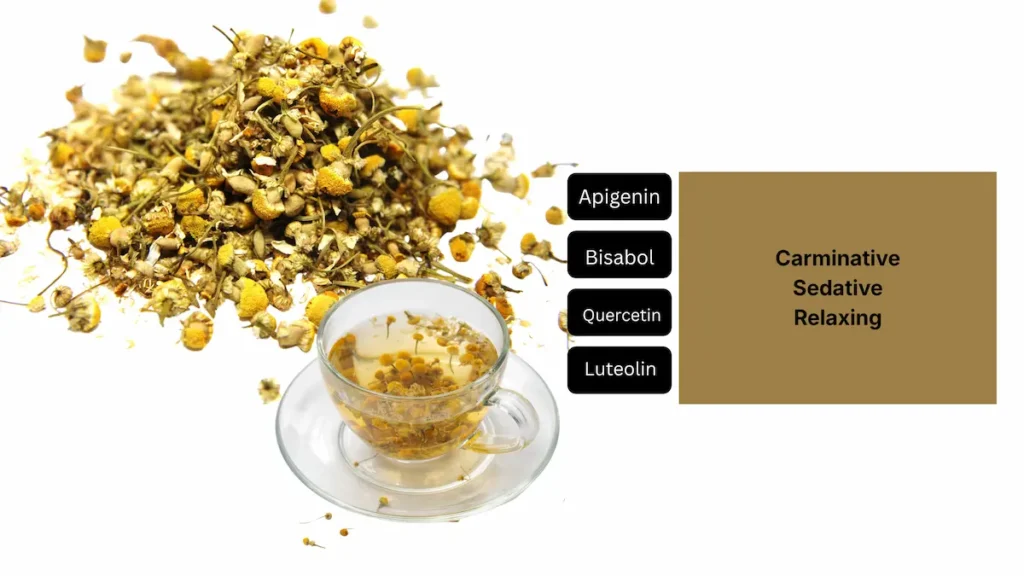
Beyond its more studied anxiolytic effects, chamomile has a long traditional record as a mild sedative. Srivastava et al. (2010) note that an aqueous extract of chamomile — essentially what a cup of tea provides — has frequently been used to calm the nerves, ease anxiety, and support sleep, historically extending to easing nightmares and general restlessness. Interestingly, this calming reputation does not appear to rest on a muscle-relaxant mechanism specifically: in the same review, isolated apigenin was found to reduce locomotor activity in vivo studies without producing a measurable anxiolytic or muscle-relaxant effect, suggesting chamomile’s traditional sedative use may draw on the interplay of its wider compound profile rather than any single constituent acting alone.
The Bioactive Compounds Behind Chamomile’s Healthful Properties
According to Sah et al. (2022), the chamomile flower yields a maximum of about 2% volatile oil, which houses more than 120 constituents. Roughly 28 terpenoids and 36 flavonoids have been isolated from different varieties of chamomile. The main oil constituents are terpenoids — chiefly sesquiterpenes and α-bisabolol. Chamazulene is not naturally present in the flower; rather, proazulene and matricin in the flower heads degrade into chamazulene during steam distillation, which is what gives the essential oil its characteristic blue colour.
Water-soluble components — flavonoids, coumarins and phenolic acids — dissolve into a cup of tea. Sah et al. (2022) report the major flavonoids as apigenin, quercetin, patuletin and luteolin, at concentrations of roughly 16.8%, 9.9%, 6.5% and 1.9% respectively, varying with species and cultivation. Alongside these sit coumarins and polyacetylenes. Several of these compounds — notably chamazulene, α-bisabolol and apigenin — have been studied for anti-inflammatory activity.
These constituents underpin the descriptive language traditionally linked with the plant. The table below sets out example terms associated with True Chamomile properties.
| Carminative | Healing |
| Sedative | Soothing |
| Relaxing | Balancing |
| Relieving | Comforting |
| Cleansing |
Apigenin and the Chamomile Nervous System Connection
Much of the interest in chamomile’s calming reputation centres on apigenin, a flavonoid found at relatively high concentration in the flowers. The LiverTox monograph (2022) notes that apigenin has “benzodiazepine-like activity and is believed to be the active component of the herbal.” Foundational laboratory work by Viola et al. (1995) identified apigenin as a central benzodiazepine-receptor ligand with anxiolytic effects, and Avallone et al. (2000) showed that apigenin reduced GABA-activated chloride currents in cultured neurons in a dose-dependent manner.
The precise mechanism is still being clarified — some experiments suggest apigenin’s effects are not fully explained by the benzodiazepine site and may involve other neurotransmission systems. Saadatmand et al. (2024) summarise the current understanding this way: the exact mechanism is not well understood, but evidence suggests apigenin and other flavonoid constituents may act on GABA, noradrenaline, dopamine and serotonin neurotransmission, or modulate the hypothalamic-pituitary-adrenocortical axis. This is the biological thread that ties chamomile to the nervous system.
This is the biological thread that ties chamomile to the nervous system.
Chamomile and the Nervous System: What Clinical Reviews of Oral Chamomile Report on Anxiety
A useful evidence-informed anchor is the systematic review by Saadatmand, Zohroudi and Tangestani (2024), published in Clinical Nutrition Research. The authors searched PubMed, Scopus and Google Scholar up to August 2023 and, from 389 records, included 10 clinical trials of oral chamomile for anxiety, spanning 2009–2022 and totalling 844 participants (approx). Of the 10 included trials, 9 concluded that chamomile was effective in reducing anxiety.
The review reports that this benefit was not confined to people diagnosed with an anxiety disorder: improvements were also observed in groups such as women experiencing menstrual-related distress, postmenopausal women, and people with insomnia accompanied by anxiety. Interventions ranged from capsules of 250 mg up to 2 g daily, or 1–2 cups of chamomile tea per day, over periods of 2 to 26 weeks. The authors also note an important limitation: because the study populations were so varied, a meta-analysis was not possible, and they call for larger, better-designed trials to establish an effective, standardised dose. Framed appropriately, this systematic review suggests chamomile potentially has an anxiolytic effect, positioning it as a gentle option for nervous-system support rather than a proven treatment.
Sleep is closely related. A systematic review and meta-analysis by Kazemi et al. (2024) in Complementary Therapies in Medicine pooled data from clinical trials and found chamomile improved sleep quality, with a significant reduction in Pittsburgh Sleep Quality Index score (weighted mean difference −1.88), though it did not improve sleep duration, sleep efficiency or daytime functioning. The observation is encouraging but measured.
Chamomile Anti Inflammatory Properties: What a 2025 Meta-Analysis of Randomised Trials Found
Chamomile’s anti-inflammatory reputation is long-standing, and there is a mechanistic rationale for it. Laboratory work has shown that chamomile can act as a selective COX-2 inhibitor, reducing prostaglandin E2 release without affecting COX-1 — a mechanism similar to that of non-steroidal anti-inflammatory drugs — and its constituents bisabolol, chamazulene and apigenin seem to be the those most studied for this activity.
The most current clinical picture comes from a systematic review and meta-analyses by Valmy et al. (2025) in Pharmaceutical Biology, which examined randomised clinical trials of chamomile published between 2004 and 2024. The authors identified 11 randomised clinical trials (10 involving oral or mucosal applications and 1 skin application), using chamomile as gels, mouthwashes, dentifrices, creams, toothpastes, nasal drops and gargles.
The findings are genuinely mixed, and this is where careful framing matters.
The honest reading is that, as an observation from this meta-analysis, chamomile shows a significant, consistent effect on pain and mucosal inflammation in oral and skin applications, while the broader anti-inflammatory picture is not yet settled — limited by the small number of qualifying studies and their heterogeneity. The authors conclude that chamomile has the potential to act as a natural anti-inflammatory agent. This is a developing area of study rather than a closed question.
Wider Therapeutic Uses: Digestive and Metabolic
Digestive and gastrointestinal support
Chamomile has a long carminative and antispasmodic tradition. The European Medicines Agency acknowledges chamomile tea and liquid extract for the symptomatic treatment of mild, spasmodic gastrointestinal complaints including bloating and flatulence, and laboratory work has demonstrated that Roman chamomile relaxes smooth muscle in visceral preparations, including human jejunum (middle section of the small intestine)— evidence that supports the traditional use. The strength of the human clinical evidence for chamomile alone remains moderate rather than definitive.
Insomnia and relaxation
As noted above, the sleep evidence (Kazemi et al., 2024) suggests a genuine but modest improvement in sleep quality. The LiverTox monograph (2022) reflects the traditional consensus, describing chamomile as widely regarded as a mild tranquilliser and sleep inducer, while noting that rigorous clinical studies remain limited.
Chamomile in Ayurveda
Chamomile also features in traditional systems that view health holistically. In Ayurveda, chamomile is known as Baboona or Babuna, and by the Sanskrit name Karpurapuspa. According to Ayurvedic classification, its qualities (gunas) are light and dry, its taste (rasa) bitter, pungent and astringent, its post-digestive effect (vipaka) pungent, and its potency (virya) cooling. It is generally described as helping to pacify aggravated pitta and kapha and to balance vata — the dosha associated with the nervous system — though sources note that, taken in excess, its light, dry nature may increase vata in some constitutions. Within this framework the three doshas — vata (air and space, governing nervous function), pitta (fire and water, governing metabolism and body temperature) and kapha (earth and water, governing stability and structure) — are kept in balance, and chamomile is valued as a gentle nervine that acts on both the mind and the digestion.
Aromatherapy, Massage and Sitz Baths
Beyond the cup, chamomile essential oil is widely used in aromatherapy, and the LiverTox monograph (2022) notes chamomile oils are found in many skin lotions, creams, soaps and cosmetics. In practice, diluted chamomile oil is used in relaxing massage blends, and chamomile infusions are added to warm sitz baths, a traditional approach for soothing and comfort. Saadatmand et al. (2024) observe that, beyond oral use, several studies report chamomile in massage therapy and aromatherapy can also have anxiety-reducing effects.
Evening Chamomile Tea for Rest and Relaxation
Because pure chamomile is caffeine-free, it lends itself to a simple, calming evening routine. A warm cup of organic chamomile tea 1 to 2 hours before sleep may facilitate restfulness for generally healthy adults, based on individual suitability and health status.
Summary
So, does chamomile tea have caffeine? In its pure form, no — and that caffeine-free quality is central to why it has been valued as a relaxing, evening-friendly drink. Around that simple answer sits a rich, research-informed and traditionally grounded picture: a plant whose bioactive compounds support a gentle chamomile nervous system role, a chamomile anti-inflammatory profile that is promising for pain and mucosal comfort while still developing for broader inflammation, and a valued place in holistic systems such as Ayurveda. Enjoyed sensibly, chamomile remains one of the most approachable and well-loved herbs in the world.
Suitability and Precautions
The information presented in this guide is subject to individual suitability and individual health status. This is an informational post only and does not constitute professional or medical advice. By its nature, the scope of this article is limited.
Frequently Asked Questions
Does chamomile tea have caffeine?
No. Pure chamomile tea, made from the dried flowers of Matricaria chamomilla, contains 0 mg of caffeine. It is a herbal infusion rather than a “true tea,” so it is naturally caffeine-free. The exception is a blended product — a chamomile mix that also includes green tea, black tea, matcha or guarana — which can carry caffeine from those added ingredients, so it is worth checking the full ingredient list.
Is chamomile anti-inflammatory?
As an observation from the current available research data, chamomile shows real potential as a mild anti-inflammatory, particularly for pain and mucosal comfort, while its broader anti-inflammatory effect remains a developing area of observation.
How does chamomile affect the nervous system?
Chamomile’s calming reputation centres on apigenin, a flavonoid that laboratory studies describe as having benzodiazepine-like activity, interacting with GABA receptors in the brain. A 2024 systematic review by Saadatmand et al. found that 9 of 10 clinical trials concluded oral chamomile was effective in reducing anxiety, across doses from 250 mg capsules to 1–2 cups of tea daily. The exact mechanism is still being clarified, and the authors call for larger, standardised trials, so this is best understood as a well-supported observation rather than a settled conclusion.
Can chamomile tea help with sleep?
A 2024 meta-analysis by Kazemi et al. found chamomile significantly improved sleep quality scores, although it did not significantly improve sleep duration or efficiency. Combined with its naturally caffeine-free profile, this supports chamomile’s traditional role as a gentle, non-stimulating part of a supplementary evening wind-down routine, based on individual suitability.
Is chamomile tea safe to drink every day?
Chamomile tea may display mild sedative qualities. Suitability is based on individual health status; seek professional advice.
What is the difference between chamomile tea and green tea for relaxation?
The key difference is caffeine. Green tea, from Camellia sinensis, naturally contains caffeine (roughly 30–50 mg per cup), which has a mild stimulant effect. Chamomile contains no caffeine at all, so it does not carry that stimulant effect and can be enjoyed later in the day without interfering with sleep.
How is chamomile viewed in Ayurveda?
In Ayurveda, chamomile is known as Baboona or Karpurapuspa. It is classified as light and dry in quality, with a cooling potency, and is traditionally described as helping to pacify aggravated pitta and balance vata — the dosha associated with the nervous system — making it a herb long associated with calm and grounding within this traditional system of medicine.
References
- Sah, A., Naseef, P. P., Kuruniyan, M. S., Jain, G. K., Zakir, F., & Aggarwal, G. (2022). A Comprehensive Study of Therapeutic Applications of Chamomile. Pharmaceuticals, 15(10), 1284. https://doi.org/10.3390/ph15101284
- Valmy, J., Greenfield, S., Shindo, S., Kawai, T., Cervantes, J., & Hong, B. Y. (2025). Anti-inflammatory effect of chamomile from randomized clinical trials: a systematic review and meta-analyses. Pharmaceutical Biology, 63(1), 490–502. https://doi.org/10.1080/13880209.2025.2530995
- Saadatmand, S., Zohroudi, F., & Tangestani, H. (2024). The Effect of Oral Chamomile on Anxiety: A Systematic Review of Clinical Trials. Clinical Nutrition Research, 13(2), 139–147. https://doi.org/10.7762/cnr.2024.13.2.139
- Kazemi, A., Shojaei-Zarghani, S., Eskandarzadeh, P., & Hashempur, M. H. (2024). Effects of chamomile (Matricaria chamomilla L.) on sleep: A systematic review and meta-analysis of clinical trials. Complementary Therapies in Medicine, 84, 103071. https://doi.org/10.1016/j.ctim.2024.103071
- National Institute of Diabetes and Digestive and Kidney Diseases. (2022). Chamomile. In LiverTox: Clinical and Research Information on Drug-Induced Liver Injury [Internet]. Bethesda (MD). https://www.ncbi.nlm.nih.gov/books/NBK548163/
- Patzelt-Wenczler, R., & Ponce-Pöschl, E. (2000). Proof of efficacy of Kamillosan cream in atopic eczema. European Journal of Medical Research, 5(4), 171–175.
- Raja, W. Y., et al. (2022). Prophylactic Anti-Osteoporotic Effect of Matricaria chamomilla L. Flower Using Steroid-Induced Osteoporosis in Rat Model and Molecular Modelling Approaches. Antioxidants, 11(7), 1316. https://doi.org/10.3390/antiox11071316
- Viola, H., et al. (1995). Apigenin, a component of Matricaria recutita flowers, is a central benzodiazepine receptors-ligand with anxiolytic effects. Planta Medica, 61(3), 213–216.
- Avallone, R., et al. (2000). Pharmacological profile of apigenin, a flavonoid isolated from Matricaria chamomilla. Biochemical Pharmacology, 59(11), 1387–1394.
- Srivastava, J. K., Shankar, E., & Gupta, S. (2010). Chamomile: A herbal medicine of the past with bright future. Molecular Medicine Reports, 3(6), 895. https://doi.org/10.3892/mmr.2010.377
- United States Department of Agriculture, FoodData Central. Beverages, tea, herb, brewed, chamomile. https://fdc.nal.usda.gov/fdc-app.html#/food-details/174156/nutrients